
A Disquiet Tide | माती उत्रांत विरता
Satyam Malhar, Wenceslaus Mendes, Pradeep Naik and Ashish Phaldesai
11 June to 25 July, 2026


A Disquiet Tide – माती उत्रांत विरता
Essay by WENCESLAUS MENDES
Mangroves are frequently presented as legible systems: symbols of ecological balance, protective buffers against climate change, or measurable carbon sinks within global environmental discourse. Increasingly, they are folded into regimes of “blue carbon,” where their capacity to store carbon is quantified, traded, and instrumentalised within offset economies. In this framing, mangroves become not only sites of resilience, but units of compensation – absorbing the excesses of industrial expansion elsewhere. Responsibility for the damages of anthropogenic development is thus displaced, transferred onto ecological systems and the communities that inhabit and sustain them. What appears as conservation is often entangled with commodification, where value is extracted through metrics, and care is reorganised through markets. Mangroves are rendered visible, measurable, and exchangeable, aligned with narratives of protection and sustainability that risk obscuring the uneven burdens they are made to carry. This exhibition departs from that stability. Here, mangroves are approached not as objects of knowledge, but as conditions of relation, instability, and lived experience. They are thick, opaque environments where boundaries blur – between land and water, salt and soil, growth and erosion. They are not simply ecosystems, but working landscapes shaped by tides, labour, and time. Along estuarine edges, these environments have long been held through intricate practices of regulation and care – sluices that open and close with the tide, embankments that hold and release, fields that shift between cultivation and submersion. These are living infrastructures: technologies of the future-past, where ecological intelligence is embedded in practice. Yet these relations are increasingly unsettled. Rising seas, erratic monsoons, and sediment disruption alter the delicate balance between freshwater and salinity. Mangroves expand into agricultural lands even as they are cleared elsewhere. Tidal flows no longer follow predictable rhythms. What once operated through calibration now moves through uncertainty. The landscape is not unified in its experience: what protects one edge may threaten another; what regenerates in one zone may erode in the next. These are contested, unevenly experienced ecologies, where environmental change is not abstract, but lived differently across bodies, occupations, and geographies. Within this, the exhibition does not seek resolution, rather it remains with disturbance. Forms appear disoriented, unable to align within familiar structures of harmony. Surfaces blur between reflection and depth, making it difficult to distinguish what is grounded from what is unstable. Systems of production: of hydro-ecology, of community, of salt, of food, of labour, extend from these ecologies, revealing how extraction and sustenance coexist within the same tidal field. The presence of bodies within these environments does not clarify them; instead, it deepens the sense of partiality. Visibility is never complete. Relations are sensed rather than fully grasped. The exhibition shifts from spectacle to structure, from viewing to inhabiting. It resists the impulse to render mangroves as coherent or resolved. Instead, it situates the viewer within an environment that is opaque, resistant, and in flux. What emerges is not a singular narrative of loss or resilience, but a field of tensions: between protection and encroachment, stability and erosion, continuity and rupture. Mangroves, in this sense, are not simply ecological formations. They are sites where ecological, social, and perceptual systems no longer align cleanly. T hey hold within them the friction of overlapping temporalities – ancestral practices, present disruptions, and uncertain futures. ‘A Disquiet Tide’ does not ask how these environments can be restored to a prior balance. Instead, it poses a more difficult question: “How do we live with systems that are already shifting, conflicting, and unstable?” To remain within this question is not to resolve it, but to recognise that living within such conditions requires new forms of attention, relation, and negotiation – where stability is no longer assumed, and coherence is no longer guaranteed. - WENCESLAUS MENDES
Satyam Malhar
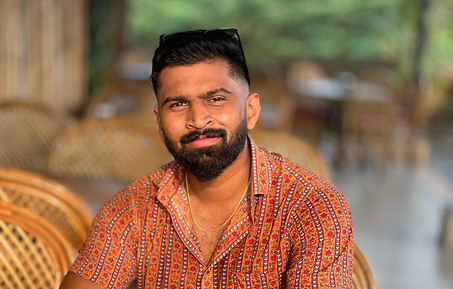
Satyam Malhar is a contemporary visual artist whose practice moves between Sawantwadi in the Konkan region of Maharashtra and Goa. Raised within a farming family and deeply connected to agrarian life, his work emerges from sustained engagement with agricultural landscapes, rural labour, and the fragile ecologies of the Western Ghats and coastal Konkan. He completed both his Bachelor’s and Master’s degrees in Portraiture from the Sir J.J. School of Art, Mumbai, where he developed a rigorous grounding in figurative and realist traditions before expanding into research-led and material-based practices.
At the centre of Malhar’s work is the nocturnal landscape — fields, forests, and estuarine edges encountered after dark. These environments are often approached through the figure of the Rakhandar, the night watchman who guards the land through uncertainty, darkness, and threat. His paintings unfold through dense shadows, moonlight, distant fires, and dim artificial illumination. Darkness becomes both atmosphere and metaphor: a space where distinctions between human and non-human, hunter and hunted, visibility and concealment begin to dissolve. Through this, his works reflect on unstable relationships between ecology, fear, protection, and coexistence within increasingly contested rural environments.
Grounded in direct engagement with farmlands, forests, salt pans, and fragile ecological zones, Malhar’s practice observes how changing environmental conditions reshape everyday life in agrarian and coastal communities. Local materials, organic textures, and environmental observation remain central to his visual language, grounding the work within the sensory and material conditions of the landscape itself.
For this exhibition, Malhar’s practice turns toward the salt pans and estuarine landscapes of the Konkan coast — fragile working ecologies where water, labour, salinity, and survival remain deeply entangled. His works reflect on how salt, drawn from water through collective labour and inherited knowledge, becomes both substance and metaphor: an essence of life shaped through
exposure, endurance, and environmental uncertainty.
Wenceslaus Mendes
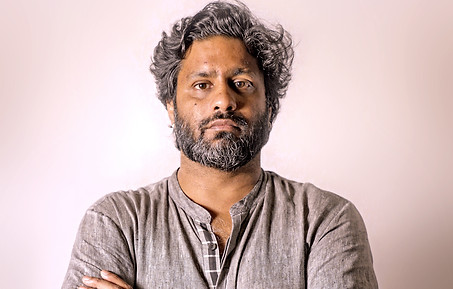
Wenceslaus Mendes is an artist, documentary filmmaker, and
independent researcher with over twenty-five years of industry experience. Apprentice-trained as a cinematographer and editor, he has worked extensively across advertising, broadcast television, and digital-web platforms. His work engages with video and technology in theatre and performance, photography, and develops conceptual and installation art projects that have travelled internationally.
His practice lies within indigenous and tribal communities, shaped by shared concerns of land and water, environment, sustainability, and climate change. Here, he frames his work within an ethos of ‘Indigenous-Eco-Futurism,’ documenting practices, oral cultures, and processes of ethno-technologies, while also exploring the politics of food, consumption, and the making and dissemination of knowledge through the creation of sensoriums. For him, local – both geospatial and temporal – and indigenous knowledge are critical in envisioning inclusive and sustainable futures.
Mendes’ research further investigates the intersections of race and caste across the Indian subcontinent. His projects examine discrimination and prejudice, purity and segregation, the making of labour, and the Indian prison system. Central to his methodology is a process he terms ‘co-labour-abling,’ where questions, processes, and outcomes are shaped collaboratively with the
communities, environments, and ecosystems from which the language of the work originates.
He is an Honors student from St. Stephen’s College, Delhi, and has a Master’s in Visual Arts from Ambedkar University, Delhi. An artist recognised by Pro Helvetia and the Swiss Arts Council through residences, he is the recipient of ‘Futures in Formation’:A Public Art Grant by the Foundation for Indian Contemporary Art (FICA) and Serendipity Arts Foundation (SAF), the VM Salgaocar Fellowship and the Mrinalini Mukherjee Foundation Creative Arts Grant.
He is the Catalyst and Curator of Goa Water Stories.
Pradeep Naik

Pradeep Naik is an artist and designer based in Mandrem, North Goa. He completed his Bachelor of Fine Arts from the Goa College of Art, Panaji, in 1999, and received his Master’s degree in Fine Arts from the Sarojini Naidu School of Fine Arts, University of Hyderabad, in 2002. Working across painting, sculpture, and material-based abstraction, Naik’s practice engages deeply with Goa’s changing landscapes, vernacular architectures, and ecological memory.
Growing up in the coastal village of Mandrem, Naik’s early experiences were shaped by observing his father’s work as a mason and contractor. Encounters with construction sites, laterite, red oxide flooring, timber, pigments, and local building techniques formed an
enduring relationship with material, structure, and land. This architectural sensibility continues to shape his visual language, where surfaces, textures, and spatial forms operate as repositories of environmental and cultural memory.
Naik’s works often emerge from rural and estuarine landscapes undergoing rapid transformation. Paddy fields, wetlands, village terrains, and coastal ecologies appear within his paintings not as documentary representations, but as fragmented and atmospheric fields shaped by absence, erosion, and recollection. Through restrained abstraction, layered tonalities, and expansive surfaces, his practice reflects on the instability of environments increasingly altered by extraction, urbanisation, tourism, and ecological degradation.
Materiality remains central to his approach. He frequently works on jackfruit wood panels rather than canvas, allowing the organic grain, density, and colour of the wood to remain visible within the composition. This engagement with locally rooted materials extends his broader interest in how landscapes, mangroves and built environments carry traces of labour, habitation, and time.
His recent works respond to shifting ecological conditions and the quiet disappearance of agrarian and coastal worlds once central to Goan life. Rather than depicting landscape as fixed scenery, Naik approaches it as an unsettled terrain where memory, infrastructure, and environmental change remain entangled. Naik has exhibited widely, including at the Kochi-Muziris Biennale collateral exhibitions, Serendipity Arts Festival, Museum of Goa, Sunaparanta Goa Centre for the Arts, and numerous group exhibitions across India. He is the recipient of the S.L. Parasher Gold Medal, multiple State Art Awards, and a Lalit Kala Akademi Scholarship.
Ashish Phaldesai

Ashish Phaldesai is a visual artist based in Canacona, Goa. He completed his Bachelor’s and Master’s degrees in Fine Art from the Goa College of Art in 2023. Working across watercolour, photography, and performance, his practice is deeply rooted in the wetlands,
estuaries, and mangrove ecologies of Goa, engaging them not simply as landscapes, but as living environments shaped by memory, atmosphere, labour, and ecological transformation.
Phaldesai’s works are marked by a quiet and immersive sensibility. Through delicate washes, layered transparencies, and subdued tonalities, he evokes landscapes that feel suspended between appearance and disappearance. Mist, reflection, humidity, and shifting light become central material conditions within his paintings, allowing the terrain to emerge as unstable, fluid, and partially obscured. Rather than presenting nature as fixed or picturesque, his practice attends to the fragile and transient qualities of coastal ecosystems, where erosion, salinity, tidal movement, and human intervention continuously reshape the land.
Extensive field observation and direct engagement with wetland environments form an important part of his process. His works emerge through prolonged encounters with these spaces, translating sensory experiences of silence, density, moisture, and temporal change into visual form. Alongside painting, his photographic and performance-based works further explore the relationship between body, landscape, and ecological memory, often reflecting on the tensions between intimacy, vulnerability, and environmental precarity.
While grounded in the ecology of Goa, Phaldesai’s practice also reflects broader concerns around contemporary environmental change and the unstable futures of coastal regions. His works resist spectacle, instead drawing viewers into contemplative encounters with landscapes that are at once serene and unsettled.
His works have been exhibited at Goa Open Arts; Students’ Biennale Kochi; Sunaparanta Art Initiator Lab, Goa; Carpe Diem Art Gallery, Goa; HH Art Spaces; Space 118; and Art Mumbai. He received the International Award at the Students’ Biennale Kochi in 2023, alongside multiple State Art Awards from Kala Academy, Goa.